The story of Micron Technology’s rise to a trillion-dollar valuation is not just about semiconductors or artificial intelligence. It is also about an unlikely investor, a potato empire, and a business philosophy that transcended industries. Long before AI became a global obsession, Idaho farmer and entrepreneur J.R. Simplot made a bold decision that would link agriculture to one of the most important technology companies in the world.
Today, as Micron stands at the center of the AI-driven semiconductor boom, Simplot’s early investment has become a defining example of how vision and timing can transform industries. What makes the story remarkable is not just the scale of success, but the unlikely path that led to it.
A Risk-Taker Shaped by Hard Beginnings
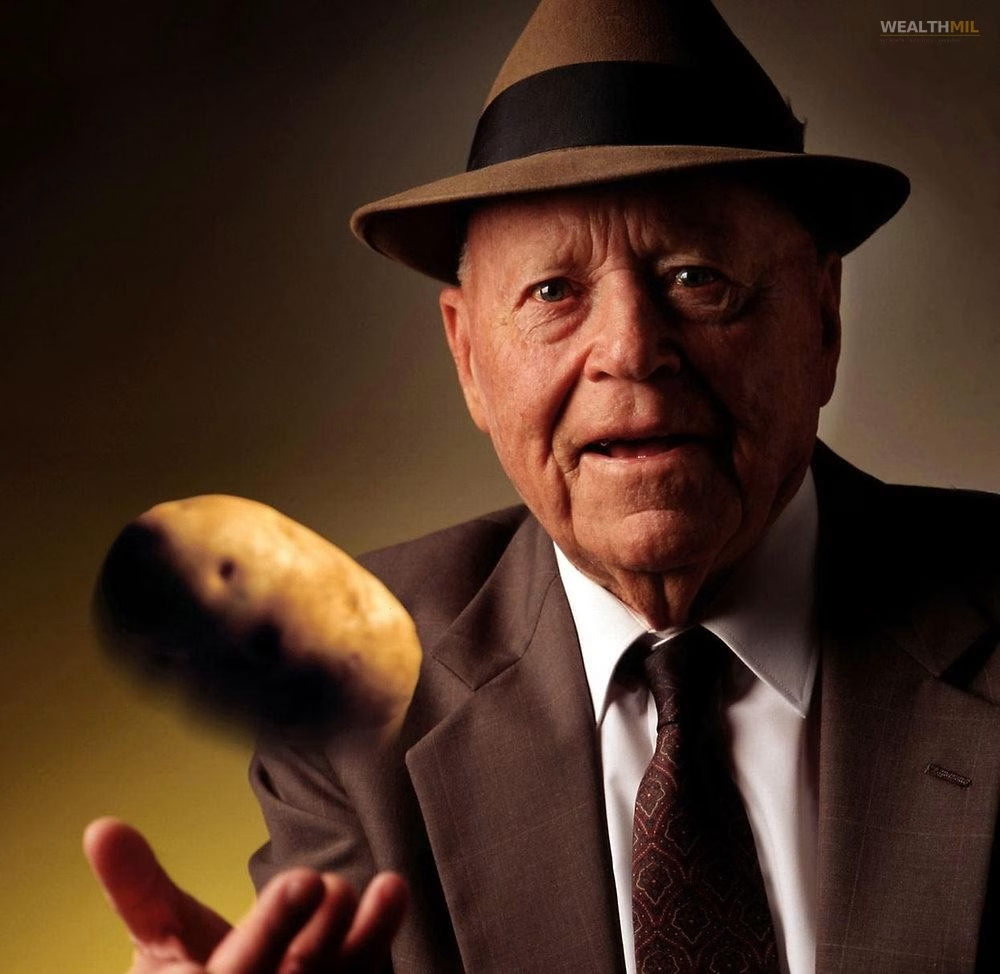
J.R. Simplot’s journey began far from Silicon Valley. Born in 1909, he grew up in Idaho during a time when farming was both physically demanding and financially uncertain. His early years were defined by hardship, but also by an instinct for spotting opportunity.
One of the most frequently cited stories about Simplot involves his teenage years, when he reportedly left home after a disagreement with his father. Instead of returning, he began trading teacher payment vouchers at a discount, using them to secure loans and invest in livestock. This early venture set the tone for his career, built on identifying inefficiencies and turning them into profit.
Simplot’s approach was simple but effective. He focused on controlling inputs, improving processes, and maximizing output. Whether it was feeding livestock with unconventional materials or expanding into potato distribution, his strategy revolved around efficiency and scale.
Building a Potato Empire That Changed Fast Food
Simplot’s real breakthrough came with potatoes. By the time he was in his 30s, he had already become a major player in the agricultural supply chain. However, it was his innovation in food processing that transformed his business into a national powerhouse.
The introduction of frozen French fries solved a major logistical challenge for fast-food chains. Restaurants previously relied on fresh potatoes, which required time-consuming preparation and led to inconsistent results. Simplot’s solution involved pre-processing the fries through blanching and partial frying before freezing them.
This innovation made it possible for companies like McDonald’s to deliver consistent products across thousands of locations. The partnership between Simplot and McDonald’s became a cornerstone of his success, turning his company into one of the largest potato processors in the United States.
The underlying principle behind this success was efficiency. Simplot understood that in a commodity-driven business, the winner is often the company that can produce the best product at the lowest cost.
The Unexpected Leap Into Technology
By the late 1970s, Simplot was already a billionaire-level entrepreneur, but his most surprising move was still ahead. In 1980, he invested $1 million in a small semiconductor startup called Micron Technology. At the time, the company operated out of modest facilities in Boise, far removed from the established tech hubs.
Simplot had no background in electronics or computing. However, his decision was not based on technical expertise but on business fundamentals. He recognized that memory chips, like agricultural products, were part of a commodity market. The same principles that applied to farming could, in theory, apply to manufacturing semiconductors.
In exchange for his investment, Simplot received a 40% stake in Micron. This early backing provided the company with the capital it needed to expand beyond design and move into manufacturing, a critical step that would define its future.

Micron’s Survival in a Brutal Industry
The semiconductor industry, particularly the market for DRAM memory, has historically been one of the most volatile sectors in technology. Prices fluctuate dramatically, and competition is intense, with global players constantly pushing for lower costs and higher efficiency.
Micron’s strategy mirrored Simplot’s philosophy. The company focused on reducing production costs, optimizing manufacturing processes, and maximizing output. This approach allowed it to survive periods when competitors exited the market due to financial pressure.
Throughout the 1980s and 1990s, Micron endured multiple downturns, including price wars and economic recessions. While many companies struggled or failed, Micron gradually established itself as one of the leading players in the memory chip industry.
The Turning Point: From Commodity to Critical Technology
For years, memory chips were viewed as a low-margin commodity product. However, the rise of smartphones, cloud computing, and data centers fundamentally changed their importance. Suddenly, memory became a critical component of modern technology infrastructure.
The real transformation came with the explosion of artificial intelligence. AI systems require vast amounts of memory to process and store data, making companies like Micron essential to the ecosystem. As demand surged, the value of high-performance memory increased dramatically.
This shift elevated Micron from a cyclical manufacturing company to a key player in the global tech terrain. The company’s ability to survive earlier downturns positioned it perfectly to benefit from this new wave of demand.
A Trillion-Dollar Milestone

On May 26, 2026, Micron reached a milestone that few could have predicted decades earlier: a market valuation exceeding $1 trillion. The surge was driven in part by increased investor confidence in AI-related technologies, as well as strong demand for advanced memory solutions.
Financial analysts have pointed to the broader semiconductor rally as a key factor, with companies involved in AI infrastructure seeing significant gains. Reports from major financial institutions, including UBS, highlighted the growing importance of memory in supporting next-generation computing systems.
The milestone serves as a testament to Micron’s long-term strategy and resilience. It also underscores the impact of Simplot’s original investment, which played a crucial role in the company’s early development.
The Legacy of an Unlikely Investor
J.R. Simplot’s story is not just about financial success but about perspective. He approached business with a focus on fundamentals, rather than trends or hype. His decision to invest in Micron was based on a belief that efficient production and strong management could overcome market volatility.
While it is unclear how much of his original stake remained over time, the potential value of that early investment is staggering. Even a small percentage of Micron’s current valuation would represent billions of dollars.
Simplot’s legacy extends beyond his own wealth. His investment helped establish a company that now plays a critical role in the global technology ecosystem. It also demonstrates how insights from one industry can be applied to another in unexpected ways.