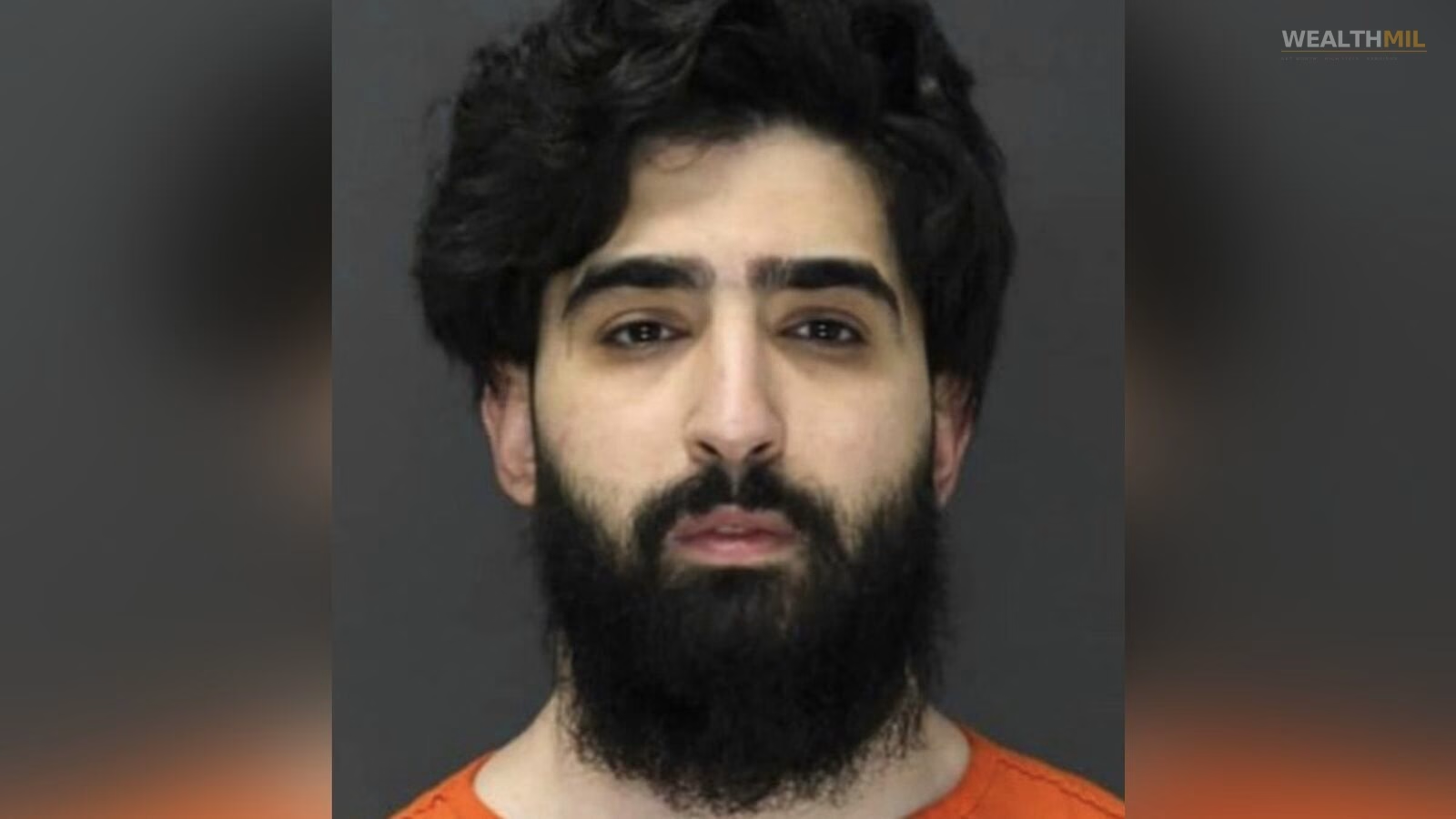
There are influencers who get rich and there are influencers who pretend to be rich. Jebara Igbara, better known online as Jay Mazini, maintained a popular Instagram account where he posted videos of himself handing out large amounts of cash to various individuals as gifts.
To nearly a million followers, he looked like the most generous man on the internet. His account showed viral moments ranging from surprise cash giveaways to an appearance alongside rapper 50 Cent, where the two handed bundles of money to drive-through customers and Burger King workers.
None of it was what it appeared to be. Behind the carefully curated generosity was a web of overlapping fraud schemes that federal investigators spent years untangling, and the final cost of Igbara’s deception was measured in stolen millions, ruined investors, and seven years inside a federal prison.
The Instagram Persona That Fooled Nearly a Million Followers
Jay Mazini became popular through Instagram, where he portrayed himself as a wealthy entrepreneur whose content often featured him giving away large sums of money to strangers, ranging from a few hundred dollars to thousands, handed out in public places or through online challenges. Igbara claimed a net worth of $33 million while cultivating a reputation for distributing stacks of cash to random people in New York. That number, like almost everything else about the Jay Mazini persona, was fabricated.

During the economic uncertainty of the COVID-19 period, Igbara took advantage of financial instability and trust within close-knit communities. He approached individuals, many from his own religious background, and encouraged them to invest in his company, Halal Capital LLC, claiming the business would generate profits through stock trading as well as buying and reselling electronics and personal protective equipment. The combination of religious familiarity, a convincing online presence, and the economic anxiety of a global pandemic made him a uniquely dangerous fraudster.
Prosecutors say the money raised through these investments funded a lifestyle that included luxury cars and heavy gambling habits. The viral generosity on Instagram, it turned out, was part of the act. It kept investors confident, attracted new victims, and gave Igbara the credibility he needed to keep the whole operation running.
Two Fraud Schemes Running at the Same Time
In reality, Igbara was perpetrating overlapping fraud schemes, scamming investors out of at least $8 million. The first operation, run through Halal Capital LLC, functioned as a Ponzi scheme. Money from new investors was used to pay earlier ones while Igbara kept a large portion for personal use. The returns seemed real for long enough to keep people invested, which is exactly how Ponzi schemes survive.
The second scheme targeted cryptocurrency sellers directly. He posted on his Instagram and other social media accounts that he was willing to pay above-market prices for various cryptocurrencies, then sent his victims doctored images of wire transfer confirmations that purported to show he had sent money as promised, when in reality the payment was never sent and Igbara was simply stealing the cryptocurrency sent by his victims.
At least four people told FBI agents they had sent over $100,000 in Bitcoin on the promise of a cash wire transfer. One victim reported being scammed out of 50 Bitcoin, with Igbara first faking $2.56 million in a wire transfer and later explaining away why the funds had not arrived. These were not careless victims. They were people who had checked their due diligence against a public figure with hundreds of thousands of followers and an apparent track record of giving money away.
The Arrest, the Kidnapping, and the Sentencing
Igbara was arrested in New York in March 2021 after federal authorities charged him with wire fraud for scheming to cheat his followers out of millions in Bitcoin. The fraud charges were serious enough on their own. What nobody had anticipated was what came next.
Mazini was accused, along with his wife and two others, of abducting a man he had been in a dispute with online, beating him, and holding him at knifepoint with a machete. He told the victim that a video of the kidnapping would be released to social media if the victim did not comply with his demands. The same platform he used to project generosity had now become a tool for intimidation.
In federal court in Brooklyn, Jebara Igbara pleaded guilty and was sentenced by United States District Judge Frederic Block to 84 months in prison for wire fraud, wire fraud conspiracy, and money laundering arising out of multiple schemes that resulted in millions of dollars in losses to trusting investors. His seven-year fraud sentence runs concurrently with a five-year sentence for the kidnapping conviction and includes time served since 2021. As part of his sentence, Igbara was ordered to pay $10 million to his victims.
Internal Revenue Service Criminal Investigation Special Agent-in-Charge Thomas Fattorusso described Igbara as a crypto con man who not only created a fake online presence to appear as a wealthy investor but also used that Instagram persona as proof of success when convincing unsuspecting victims to invest in his schemes. The U.S.

Attorney for the Eastern District of New York added that Igbara had shamefully targeted his own religious community, taking advantage of their trust to fund reckless spending. When the verdict came down, Jay Mazini’s Instagram account had already been deleted. The cash giveaways, the viral videos, the claimed millions were gone. What remained was a court record, ten million dollars owed to victims, and a prison sentence that finally matched the scale of the damage done.
The Jay Mazini story is not just a cautionary tale about one fraudulent influencer. It is a blueprint for how social media can be weaponized to manufacture trust at scale, and how quickly that trust can be turned into financial devastation for real people. Igbara never needed traditional credibility because Instagram gave him something more powerful: visibility.
Millions of people watched him give money away and assumed the wealth was real, which is precisely what he needed them to think. As long as platforms reward spectacle over scrutiny, the conditions that made Jay Mazini possible are not going anywhere.