
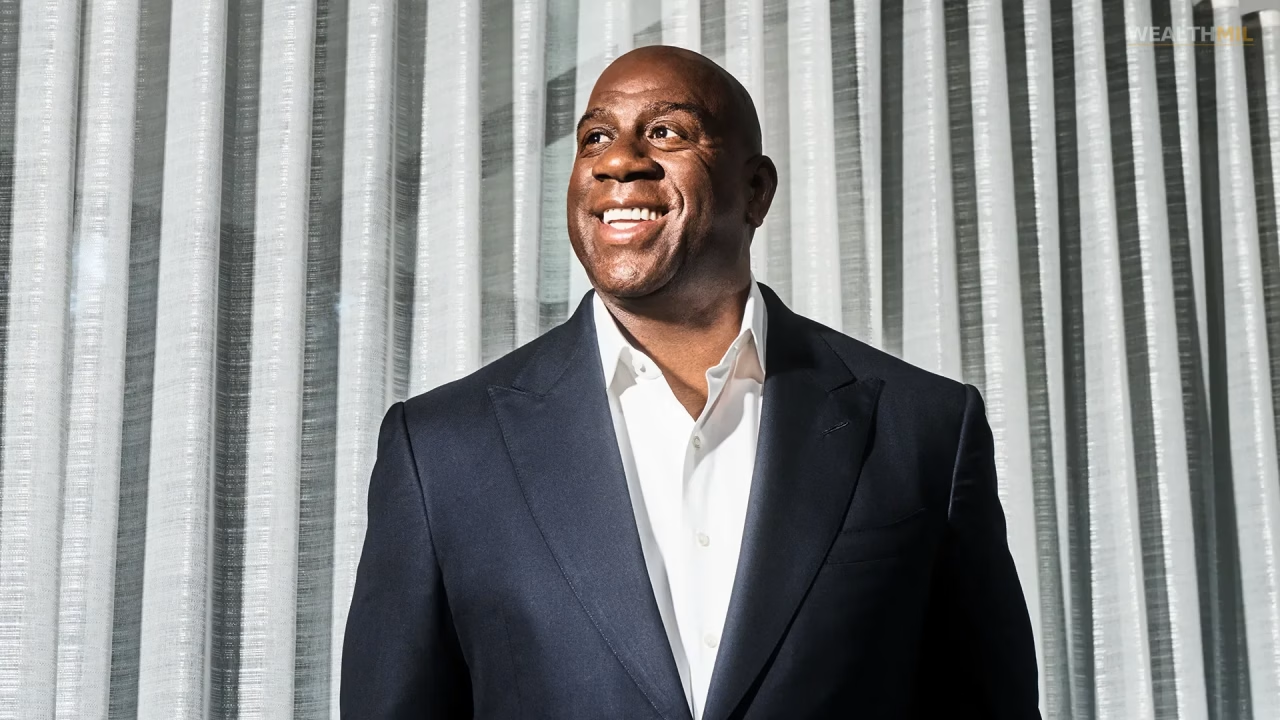
A decades-old business story involving NBA legend Magic Johnson has gone viral again, reigniting one of the most discussed “what if” scenarios in sports finance history. The clip, circulating widely on social media in June 2026, features Johnson recalling a moment from 1979 when he was entering the NBA as one of the most sought-after young athletes in the world.
In the resurfaced interview, Johnson claims that Nike once approached him with a groundbreaking offer. At the time, the relatively young company reportedly could not match the cash deals offered by established brands like Converse, but instead proposed something different: equity. As Johnson recalls, Nike co-founder Phil Knight suggested a stock-based agreement rather than a traditional endorsement payout.
According to Johnson’s retelling, he chose immediate cash over stock—an option that, in hindsight, may have cost him billions.
The Origin of the “$5 Billion Mistake” Story
The narrative gained even more traction after being dramatized in HBO’s Winning Time: The Rise of the Lakers Dynasty, which exaggerated the potential loss to a staggering $5.2 billion. That version turned the story into a pop culture moment, presenting it as one of the greatest financial “what ifs” in sports history.
However, as noted in a report by Joey Held in Sports News (June 21, 2026), there is no verified evidence that such a formal Nike stock offer ever existed in the way Johnson describes. Neither Nike nor Phil Knight has publicly confirmed the existence of a structured equity deal being offered to Johnson in 1979.
More importantly, historical timelines suggest complications. Johnson had already signed with Converse shortly after leading Michigan State to the NCAA championship in 1979, making it difficult to place any serious Nike negotiation within the narrow window before that agreement.
Even if the hypothetical scenario is taken at face value, the numbers do not fully support the viral $5 billion figure often repeated online.
Financial analysts estimate that if Johnson had received approximately 100,000 Nike shares around the company’s early public phase in December 1980, stock splits over time would have expanded that to roughly 12.8 million shares today. At current trading levels near $45 per share, that would place the raw value at approximately $580 million.
That figure, while enormous, is significantly lower than the viral narrative suggests.
Where the Billion-Dollar Valuation Comes From
The only way the story approaches the $1 billion mark is through long-term dividend reinvestment. If every dividend paid over more than four decades had been automatically reinvested into additional Nike stock, compounding growth could theoretically push the portfolio beyond $1 billion.
However, this scenario assumes perfect long-term holding behavior with no selling, no portfolio adjustments, and no liquidity needs over nearly 50 years—an unlikely real-world situation, especially for an investor active in multiple business ventures.
Despite its popularity, the Nike story remains unverified. Most sports business historians note that Nike did not commonly issue equity-based endorsement deals until later, with athletes like Michael Jordan often cited as the early standard for such arrangements.
Johnson, meanwhile, has built a highly successful post-NBA business career, with an estimated net worth of around $1.6 billion, according to widely cited financial profiles. Even without the Nike stock scenario, his financial legacy remains one of the strongest among former athletes.
The story, then, sits in a familiar space between memory, mythology, and media amplification—part anecdote, part cautionary tale, and part entertainment-driven exaggeration.