Michael Armand Hammer, son of the legendary industrialist and art collector Armand Hammer, occupied a unique position within one of America’s most prominent business dynasties. Born into extraordinary wealth and privilege as the heir to the Occidental Petroleum fortune, Michael’s life unfolded against a backdrop of immense family wealth, corporate power, and personal tragedy. His net worth at the time of his death in 2022 reflected decades of business involvement, inheritance complexities, and the intricate financial legacy left by his father.
Understanding Michael Armand Hammer’s wealth requires examining his role within the family business empire, his personal ventures, the inheritance he received from his father’s estate, and the subsequent distribution of wealth to the next generation.
The Hammer family fortune, built primarily through Occidental Petroleum and supplemented by art collections and real estate holdings, passed through Michael’s hands during a transitional period that would ultimately lead to public scrutiny following controversies involving his grandson, actor Armie Hammer. This comprehensive examination explores Michael Armand Hammer’s net worth, the sources of his wealth, and his financial legacy.
Early Life and Position Within the Hammer Dynasty
Michael Armand Hammer was born on September 8, 1955, to Armand Hammer and his second wife, Frances Barrett Tolman. As the only son of Armand Hammer, Michael occupied a privileged position as heir apparent to a vast business empire centered around Occidental Petroleum, the oil and gas company that his father had transformed into an international powerhouse.
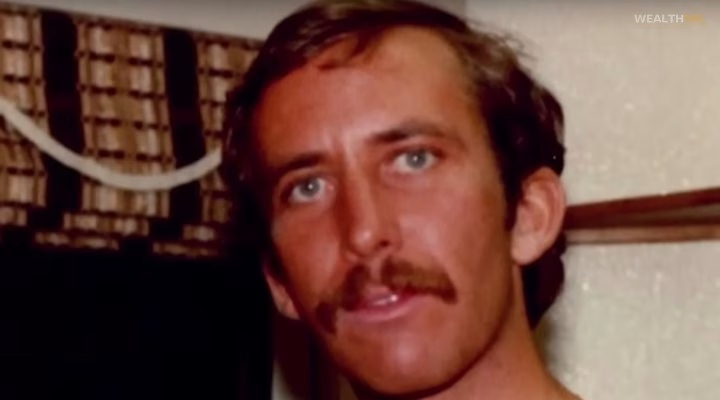
Growing up in the shadow of his legendary father presented both advantages and challenges. Armand Hammer’s larger-than-life personality, business acumen, and international connections created an environment of immense wealth and influence. The family maintained multiple residences, extensive art collections, and connections to political and business leaders worldwide.
Michael’s childhood and early adulthood unfolded during the height of his father’s business success. Occidental Petroleum’s expansion throughout the 1960s and 1970s generated enormous wealth, positioning the Hammer family among America’s richest dynasties. Michael attended prestigious schools and grew up with access to resources and opportunities available only to the ultra-wealthy.
However, the relationship between Armand and Michael reportedly experienced tensions. Armand Hammer’s demanding personality and high expectations created pressure on his son to live up to the family legacy. Michael’s role within the family business would eventually involve positions at Occidental Petroleum and various Hammer family entities, though he never achieved the independent business success that characterized his father’s career.
The wealth Michael would eventually inherit represented not just his father’s business success but also the accumulation of art, real estate, and investments spanning decades. This inheritance would form the foundation of Michael’s own net worth and his ability to maintain the family’s wealthy status.
Armand Hammer’s Estate and Michael’s Inheritance
Armand Hammer died on December 10, 1990, leaving behind an estate that became the subject of significant legal disputes and public scrutiny. The distribution of Armand’s wealth to Michael and other heirs proved far more complicated than a straightforward inheritance, involving contested wills, legal battles, and questions about the actual size of the estate.
Armand Hammer’s will created controversy immediately upon his death. Despite his public image as a billionaire, the estate’s actual value proved difficult to determine. Various estimates placed Armand’s net worth at the time of his death between 200 million and 800 million dollars, a wide range reflecting complexities in valuing assets including Occidental Petroleum stock, art collections, real estate holdings, and international investments.
Michael Armand Hammer inherited a significant portion of his father’s estate, though the exact amount remained subject to legal interpretation and dispute. The inheritance included financial assets, real estate properties, portions of art collections, and other valuable holdings accumulated during Armand’s lifetime.
Legal challenges to Armand’s will came from multiple parties, including his third wife, Frances, and others who claimed entitlement to portions of the estate. These disputes stretched on for years, complicating the distribution of assets and creating uncertainty about the ultimate value Michael would receive.
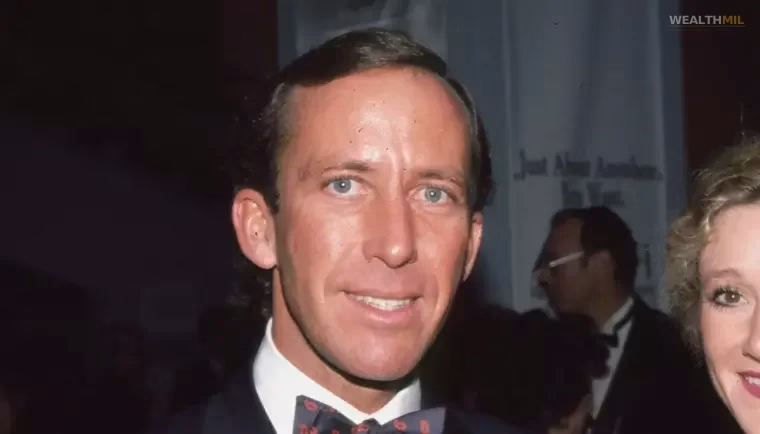
Despite these complications, Michael emerged from the inheritance process as a wealthy man in his own right. The assets he received provided financial security and allowed him to maintain an affluent lifestyle consistent with the Hammer family’s status. However, the inheritance also came with responsibilities for managing complex assets and steering the public attention surrounding the Hammer name.
Business Ventures and Career
Michael Armand Hammer’s professional career involved various business activities, though his ventures never achieved the prominence or success of his father’s Occidental Petroleum empire. His business involvement primarily centered on managing inherited assets, serving in roles within Hammer family entities, and pursuing selected entrepreneurial ventures.
Michael held positions within Occidental Petroleum at various points, benefiting from his family connection to the company his father had built. However, his role within the corporation remained relatively modest compared to his father’s dominant leadership position. The professional relationship between Michael and Occidental reflected his status as a significant shareholder rather than an operational executive driving company strategy.
Beyond Occidental Petroleum, Michael engaged in business activities including real estate investments and involvement with the Armand Hammer Foundation, an entity established by his father to manage philanthropic activities and art collections. These roles provided income and influence while leveraging the Hammer family name and resources.
Michael’s business approach differed substantially from his father’s aggressive, deal-making style. Rather than building new enterprises or pursuing transformative business strategies, Michael focused primarily on preserving and managing inherited wealth. This conservative approach suited his personality and circumstances, though it meant he would never emerge as a business leader in his own right.
The income generated from Michael’s business activities, combined with returns on inherited investments and assets, contributed to his overall net worth throughout his adult life. However, the foundation of his wealth remained the inheritance from his father rather than independently generated business success.

Real Estate Holdings and Lifestyle
Michael Armand Hammer maintained an affluent lifestyle supported by substantial real estate holdings and the trappings of generational wealth. His properties reflected the Hammer family’s taste for luxury and their position within America’s upper class.
The family maintained residences in exclusive locations, including properties in California that served as primary homes and vacation retreats. These real estate holdings represented significant assets within Michael’s net worth portfolio, with values ranging into the millions of dollars for individual properties.
Michael’s lifestyle included the amenities expected of someone from an ultra-wealthy family, including household staff, luxury vehicles, travel, and membership in exclusive clubs and organizations. These expenditures, while substantial, remained well within the financial means provided by his inheritance and ongoing investment returns.
The Hammer family’s art collection, partially inherited by Michael, represented another significant asset category. While portions of Armand’s art collection went to museums and cultural institutions, valuable pieces remained with the family, contributing to the overall wealth picture.
Michael’s real estate strategy involved maintaining properties that served both personal enjoyment and investment purposes. The appreciation of California real estate values over decades added substantially to the net worth represented by these holdings, creating wealth growth beyond the original inheritance values.
Wealth Distribution to the Next Generation
Michael Armand Hammer had two children, Viktor and Armie, who would eventually become heirs to portions of the family wealth. Michael’s approach to wealth management included considerations for passing assets to the next generation while maintaining financial security during his lifetime.
The distribution of wealth to Viktor and Armie occurred through various mechanisms including trust structures, direct gifts, and ultimately inheritance following Michael’s death. Michael established financial arrangements intended to provide for his children while preserving family wealth across generations.

However, the Hammer family fortune that Michael inherited from Armand would undergo significant depletion by the time it reached the third generation. Various factors contributed to this wealth erosion, including lifestyle expenditures, investment losses, legal fees, taxes, and the division of assets among multiple heirs.
Viktor Hammer’s death in 2024 represented another inflection point for family wealth distribution. The assets Viktor possessed passed to his heirs, further fragmenting the original Hammer fortune accumulated by Armand.
Armie Hammer, who achieved fame as an actor before becoming embroiled in scandal and legal troubles, found himself in financial difficulty despite his family background. Reports suggested that by the time wealth reached Armie’s generation, the vast Hammer fortune had diminished substantially from its peak during Armand’s lifetime.
Michael’s wealth management decisions and the structures he established for passing assets to his children would ultimately prove insufficient to maintain the family’s ultra-wealthy status across multiple generations. The pattern reflected common challenges facing inherited wealth, including the dilution effect of dividing assets among multiple heirs and the difficulty of preserving fortunes without ongoing business success generating new wealth.
Estimated Net Worth at Time of Death
Michael Armand Hammer died on November 20, 2022, at age 67. Estimating his net worth at the time of death requires analyzing available information about his assets, lifestyle, and financial situation in his final years.
Various sources and reports suggest Michael’s net worth at death ranged between 1.5 million and 10 million dollars, a significant decline from the hundreds of millions his father Armand possessed. This estimate reflects the reality that much of the Hammer family fortune had been depleted through several mechanisms over the decades following Armand’s death.
The reduction in wealth from Armand’s generation to Michael’s reflects several factors. First, estate taxes and legal fees associated with Armand’s death consumed a portion of the inheritance. Second, Michael’s own lifestyle expenditures over three decades drew down inherited assets. Third, investment returns may not have kept pace with spending, causing gradual wealth erosion.

Additionally, Michael apparently made financial distributions to his children during his lifetime, transferring wealth to the next generation before his death. These gifts reduced his personal net worth while providing for Viktor and Armie.
The contrast between Michael’s estimated net worth and public perception of the Hammer family wealth illustrates how quickly fortunes can diminish across generations. While the Hammer name remained associated with wealth and privilege, the actual financial resources available to Michael in his later years had contracted substantially.
Real estate holdings likely represented a significant portion of Michael’s remaining assets at death. Properties in California and potentially other locations provided both residence and investment value, though likely subject to mortgages or other encumbrances that reduced net equity.
The Hammer Legacy and Wealth Lessons
Michael Armand Hammer’s financial story provides insights into the challenges of inherited wealth and the difficulty of maintaining multi-generational fortunes without continued business success. His experience reflects patterns common among children of ultra-wealthy individuals who inherit substantial assets but struggle to preserve them across subsequent generations.
The Hammer family wealth, built by Armand through aggressive business building and deal-making, required similar entrepreneurial energy to maintain and grow. Michael’s more passive approach to wealth management, focused on preservation rather than expansion, proved insufficient to maintain the fortune at its peak levels.
The public scrutiny of the Hammer family following controversies involving Armie Hammer brought renewed attention to the family’s financial situation. Reports suggesting the depletion of the family fortune contradicted public assumptions about generational wealth, revealing that even families associated with legendary business success can experience financial decline.
Estate planning and wealth transfer strategies employed by Michael, while presumably advised by legal and financial professionals, ultimately could not prevent significant wealth erosion. The combination of taxes, lifestyle costs, multiple heirs, and the absence of new wealth generation created an arithmetic challenge that no planning strategy could fully overcome.

The lesson from Michael Armand Hammer’s financial trajectory emphasizes that inherited wealth alone, without ongoing business acumen and disciplined financial management, rarely sustains across multiple generations. The Hammer name may carry historical weight, but by Michael’s death, the actual financial substance supporting that name had diminished dramatically from its peak.
Michael Armand Hammer’s net worth, estimated between 1.5 million and 10 million at his death in 2022, represented a substantial reduction from the hundreds of millions his father Armand Hammer possessed at the peak of the family fortune. As the sole son and primary heir to Armand’s estate, Michael inherited significant wealth in 1990 that provided financial security and an affluent lifestyle for over three decades. However, the combination of estate taxes, legal fees, lifestyle expenditures, distributions to the next generation, and the absence of new wealth-generating business success gradually eroded the family fortune.
Michael’s conservative approach to wealth management, focused on preservation rather than aggressive business building, proved insufficient to maintain the ultra-wealthy status established by his father. The Hammer family legacy illustrates fundamental challenges facing inherited wealth across generations, demonstrating that even fortunes built by legendary industrialists can diminish substantially within just two generations without continued entrepreneurial success. Michael’s financial story serves as both a cautionary tale about wealth preservation and a reminder that historical family names may not reflect current financial realities.