
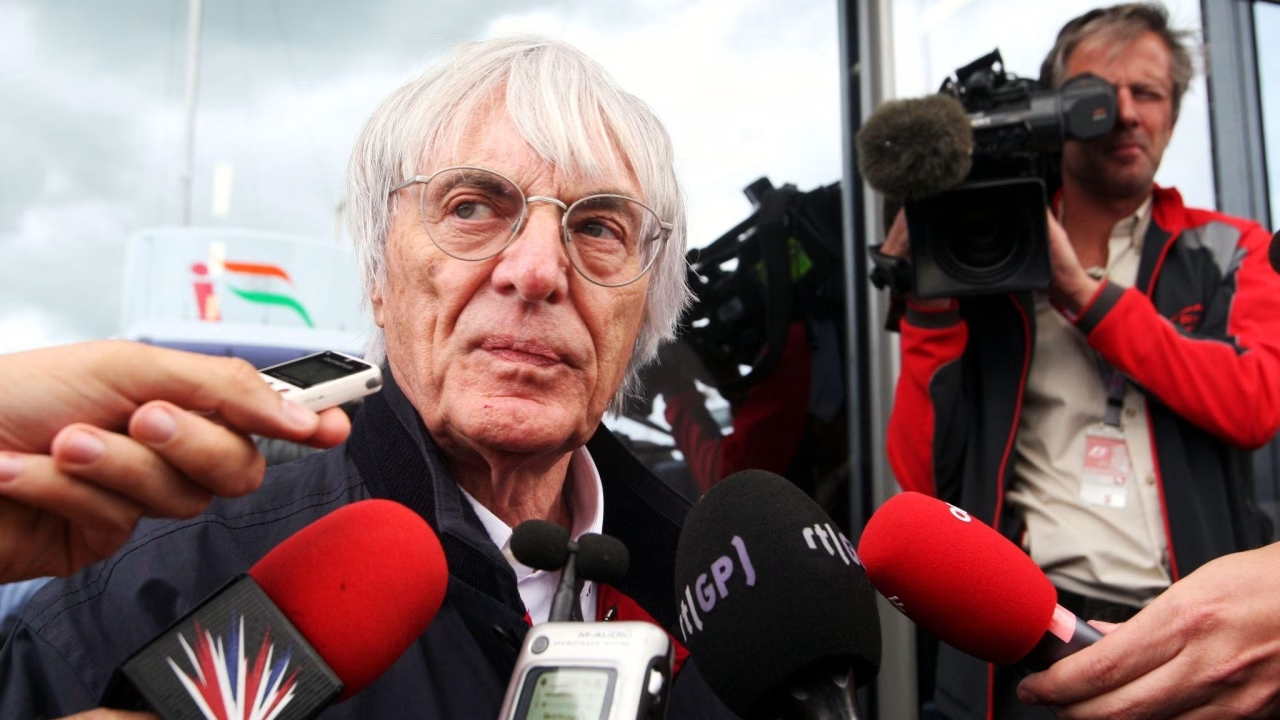
Bernie Ecclestone remains one of the most influential and controversial figures in motorsport history. His journey from a modest upbringing in England to becoming the commercial architect of Formula One is often described as one of the most unlikely billionaire success stories in sports.
With an estimated net worth of $2.5 billion, according to Celebrity Net Worth, Ecclestone’s fortune was not built through driving or engineering, but through recognizing where the real money in racing truly existed. His story is less about speed on the track and more about control behind the scenes.
From Humble Beginnings to Early Hustle
Bernard Charles Ecclestone was born in 1930 in rural Suffolk, England, to a working-class family. His father was a fisherman, and financial stability was far from guaranteed during his early years. After moving to London, Ecclestone left school at 16 and began working at a gasworks, testing gas purity to earn a living.
Even at a young age, he showed an instinct for business. Stories from his childhood describe him running multiple paper routes and reselling goods to classmates for profit. That mindset of finding margins and controlling transactions became a defining trait throughout his career.
His first serious business venture came through selling motorcycle parts, eventually forming a dealership with partner Fred Compton. This early success not only gave him capital but also introduced him to the world of motorsport.
A Short Racing Career That Changed His Direction
Ecclestone initially tried to build a career as a racer, competing in lower-tier events and even attempting to enter Formula One races in 1958. However, he failed to qualify and soon realized that his future did not lie behind the wheel.
His time as a driver was marked by danger and instability, including multiple crashes. Instead of persisting, Ecclestone pivoted toward the business side of racing, a decision that ultimately defined his legacy.
He later managed driver Stuart Lewis-Evans, whose tragic death following a crash deeply affected him and temporarily pushed him away from the sport. However, Ecclestone returned with a sharper focus and greater financial backing, determined to succeed on his own terms.
Buying Into Formula One and Changing the Game
Ecclestone’s real breakthrough came in 1971 when he purchased the Brabham Formula One team for a relatively modest sum. What seemed like a standard team acquisition turned into a strategic masterstroke.
Owning a team allowed him to understand how Formula One operated at every level, from sponsorship deals to race organization. More importantly, he realized that the sport was commercially fragmented, with teams and organizers failing to maximize its global potential.
Through the Formula One Constructors Association (FOCA), Ecclestone began consolidating power among teams. His key insight was simple but transformative: the real value of Formula One was not just in racing, but in controlling its commercial rights and global presentation.
Building Formula One Into a Billion-Dollar Business
During the 1980s, 1990s, and early 2000s, Ecclestone effectively reshaped Formula One into a global media empire. He centralized television rights, negotiated lucrative deals with broadcasters, and introduced hosting fees that cities around the world were willing to pay for the prestige of hosting a Grand Prix.
His influence was so dominant that he became known as the “F1 Supremo,” a figure who controlled access to the sport’s most valuable assets. He understood exclusivity better than most, positioning Formula One as a luxury product associated with wealth, glamour, and high-performance engineering.
By the time Liberty Media acquired Formula One in a deal valuing it at around $8 billion, Ecclestone had already built the commercial framework that made such a valuation possible. Although he stepped down from his executive role after the sale, the system he created continues to drive the sport’s global success.
Controversies, Legal Issues, and Late-Career Challenges
Ecclestone’s career has not been without controversy. He was frequently criticized for taking Formula One to countries with questionable human rights records and for his aggressive negotiating tactics. His public statements over the years also drew backlash.
In 2014, a bribery case in Germany ended after Ecclestone agreed to a $100 million settlement, avoiding a full trial. More significantly, in 2023, he pleaded guilty in the UK to fraud related to undeclared overseas assets. He received a suspended prison sentence and agreed to pay a massive financial settlement exceeding £650 million to HM Revenue & Customs.
These legal battles marked a dramatic shift in public perception, highlighting the risks and complexities tied to managing vast global wealth.
The Billionaire Legacy and Car Collection
Beyond business, Ecclestone became known for owning one of the most valuable private collections of Formula One cars. The collection included historic vehicles from Ferrari, Brabham, and other iconic manufacturers, representing decades of racing history.
In 2025, the collection was sold to Mark Mateschitz, further cementing Ecclestone’s reputation as a figure deeply tied to the sport’s legacy. While the exact sale price was not publicly disclosed, estimates suggested it was worth hundreds of millions of dollars.
This sale symbolized a full-circle moment, as Ecclestone effectively passed part of Formula One’s history to a new generation connected to the sport’s modern era.