


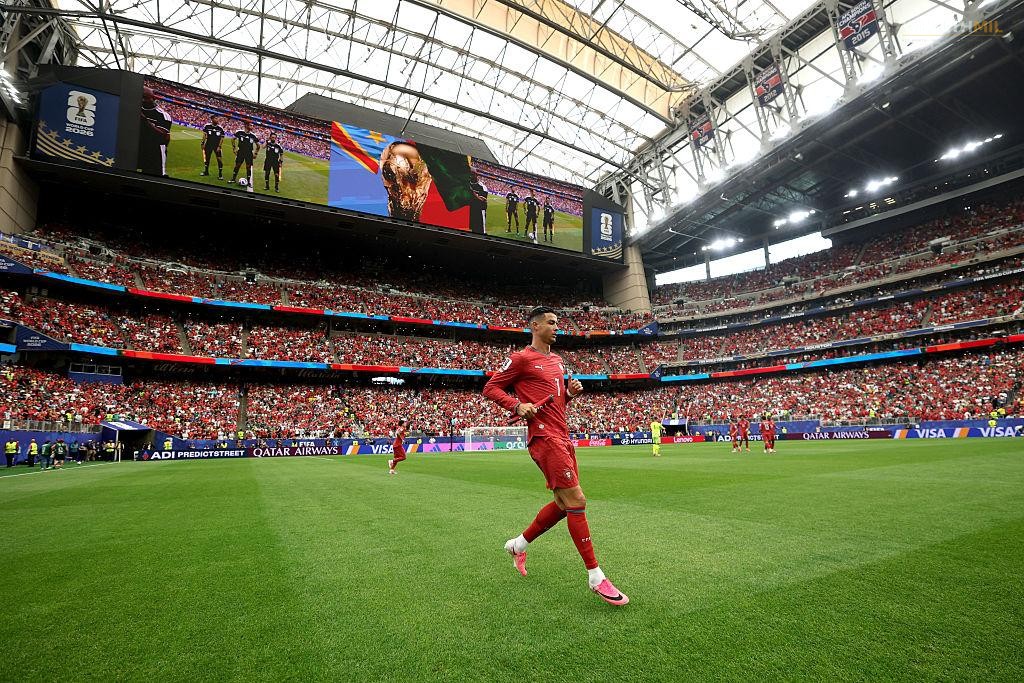
Cristiano Ronaldo’s international career appears to have reached its final chapter following Portugal’s elimination from the 2026 FIFA World Cup. While the legendary forward leaves the tournament without the one major trophy that eluded him throughout his career, his club career remains tied to one of the richest contracts ever awarded to a professional athlete.
The Portuguese icon is set to continue playing for Saudi Pro League club Al Nassr under a deal reportedly worth hundreds of millions of dollars. However, the contract’s most remarkable feature isn’t its headline salary—it is the fact that much of Ronaldo’s employment income in Saudi Arabia is effectively free from personal income tax.
According to Celebrity Net Worth, Saudi Arabia’s tax system allows Ronaldo to retain virtually all of his salary, making his earnings significantly more valuable than similarly sized contracts in countries with higher tax rates.
Why Ronaldo’s Saudi Arabia salary is effectively tax-free
Saudi Arabia does not levy personal income tax on employment earnings. That means salaries, signing bonuses, and many employment-related incentives received by workers in the country are generally exempt from personal income taxation.
For Ronaldo, this makes a dramatic financial difference.
Unlike countries such as the United States, Portugal primarily taxes individuals based on tax residency rather than citizenship. If an individual no longer qualifies as a Portuguese tax resident and earns employment income outside Portugal, that foreign salary is generally not subject to Portuguese income tax, subject to applicable tax laws and residency rules.
As a result, Ronaldo’s reported Al Nassr salary can largely remain untouched by income taxes, provided his tax residency aligns with those regulations. Tax professionals note that residency status depends on several legal factors, and individual circumstances may differ.
One of the richest contracts in sporting history
Ronaldo joined Al Nassr in late 2022 after leaving Manchester United and immediately became the world’s highest-paid athlete.
Multiple outlets, including Forbes have consistently ranked Ronaldo among the highest-earning athletes globally since his move to Saudi Arabia.
Reports indicate his original agreement was worth roughly $535 million over two-and-a-half years. In 2025, he reportedly signed another extension that could raise his total Saudi earnings well beyond $1 billion before bonuses over the course of his stay with Al Nassr.
Several reports have also stated that the package includes additional benefits such as:
- A minority ownership stake in Al Nassr.
- Private jet expenses.
- Extensive household staff support.
- Performance-related bonuses and commercial opportunities.
While exact figures vary across reports, industry analysts agree that Ronaldo’s Saudi agreement is among the most lucrative contracts ever signed by an athlete.
How different would this contract be for an American athlete?
One of the key reasons Ronaldo’s deal attracts financial attention is how differently it would be treated under U.S. tax law.
Unlike Portugal, the United States taxes its citizens on worldwide income regardless of where they live. An American athlete earning hundreds of millions of dollars overseas would still generally owe U.S. federal income taxes, and potentially state income taxes depending on residency rules.
Although certain foreign income exclusions exist, those provisions cover only a relatively small portion of extremely high salaries and would have little impact on contracts of Ronaldo’s magnitude.
This means an American athlete would likely need to earn substantially more before taxes to match Ronaldo’s reported take-home income.
Ronaldo’s Saudi move continues to spark debate
Ronaldo’s transfer to Saudi Arabia has never been viewed solely through a financial lens.
Human rights organizations have repeatedly criticized Saudi Arabia’s growing investment in global sports, arguing that the country is using high-profile sporting events and athletes to improve its international image—a practice commonly referred to as “sportswashing.”
Ronaldo has frequently been at the center of those discussions because his arrival dramatically increased worldwide interest in the Saudi Pro League.
His signing also paved the way for numerous other international stars to move to Saudi clubs, significantly raising the league’s global profile.
Despite the criticism, the financial success of the strategy is difficult to dispute. Before Ronaldo’s arrival, Al Nassr received relatively limited international attention. Today, the club regularly features in global football headlines, while Ronaldo remains one of the sport’s biggest commercial attractions.
With his World Cup journey likely over, the 41-year-old now returns to Saudi Arabia where, both on and off the pitch, he remains one of the most valuable figures in world football.