

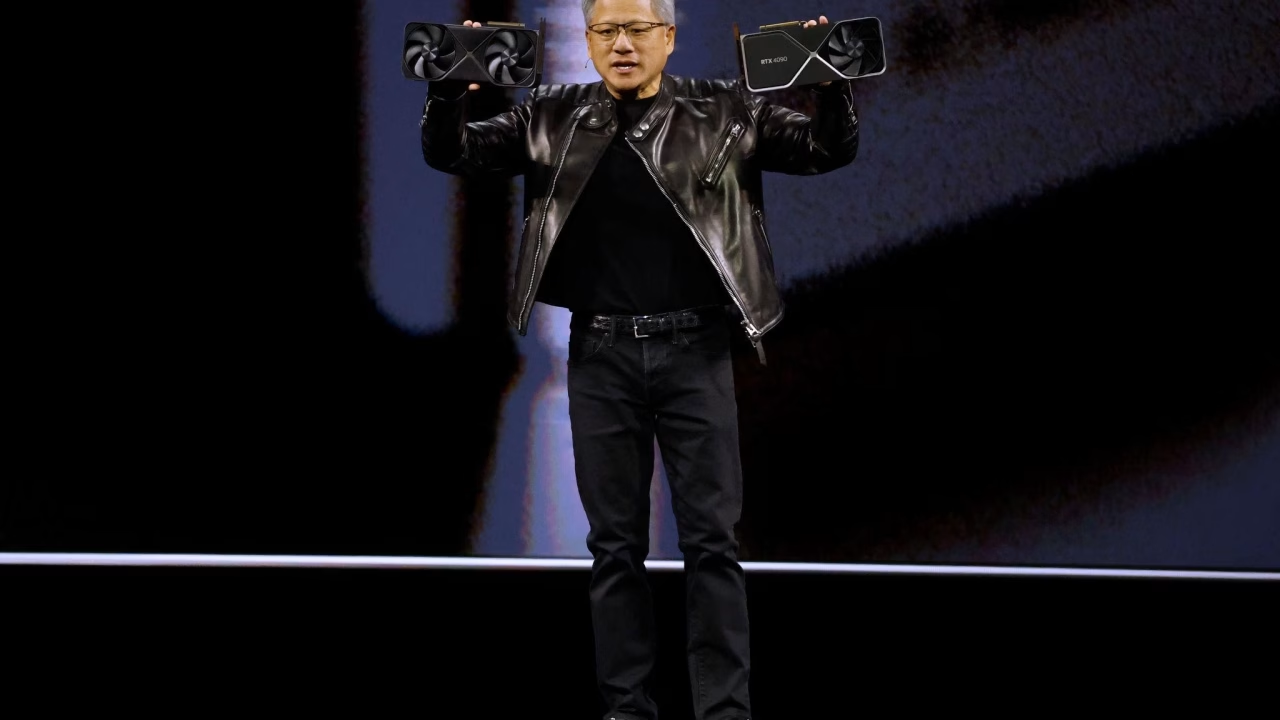
In 2007, Jensen Huang made what seemed like a relatively modest philanthropic move. Alongside his wife Lori, the NVIDIA co-founder donated 370,000 company shares, valued at around $12.6 million at the time, to establish the Jen-Hsun and Lori Huang Foundation. Nearly two decades later, that same contribution has transformed into one of the most valuable charitable endowments in the world.
What began as a small, low-profile foundation has quietly grown into a multi-billion-dollar powerhouse, largely fueled by NVIDIA’s meteoric rise. As the company surged to become one of the most valuable corporations globally, the Huangs’ early donation multiplied in ways few could have predicted.
From Gaming Chips to Trillion-Dollar Growth
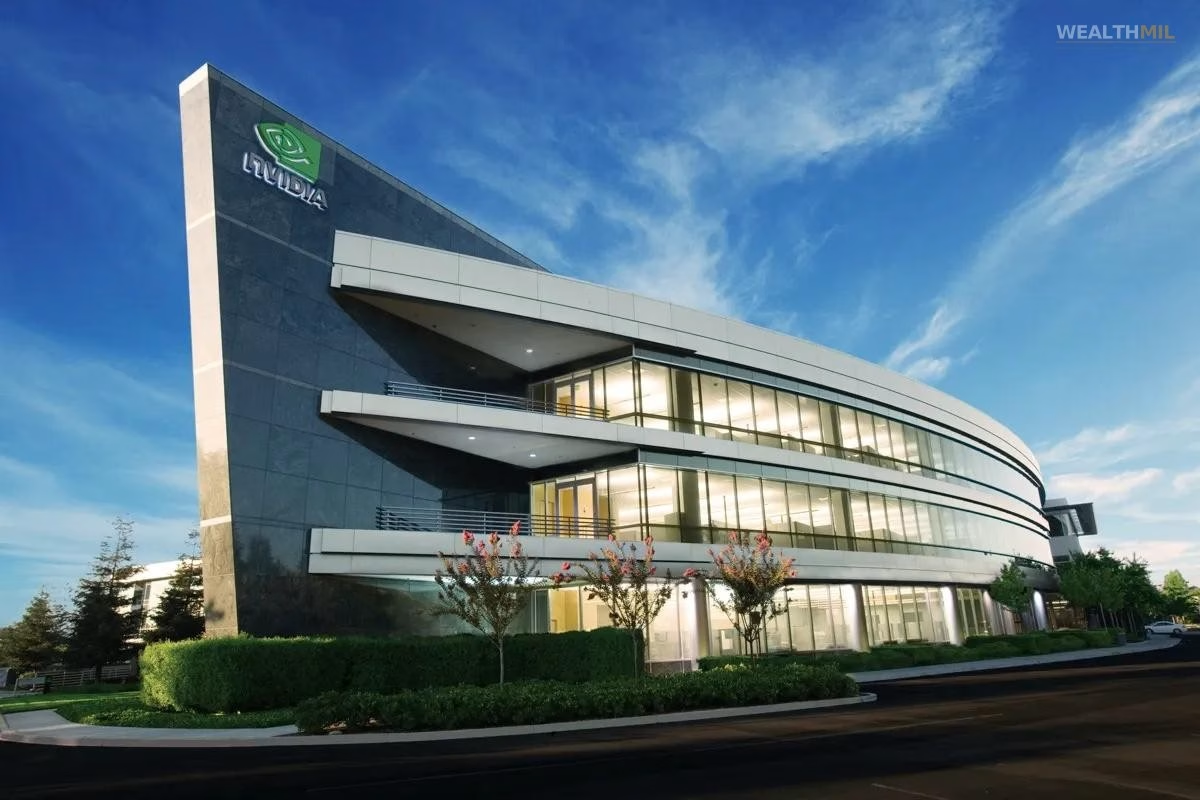
NVIDIA’s journey explains much of this dramatic wealth expansion. Founded in 1993 by Jensen Huang, Chris Malachowsky, and Curtis Priem, the company initially focused on graphics processing units for gaming. After its 1999 IPO, NVIDIA steadily grew through the 2000s, overcoming setbacks like the dot-com crash and eventually establishing dominance in graphics technology.
However, the real turning point came much later with the rise of artificial intelligence and high-performance computing. NVIDIA’s GPUs became essential for AI workloads, data centers, and machine learning, driving explosive growth in both revenue and valuation. By 2026, the company’s market cap has approached an astonishing $6 trillion, placing it among the most valuable companies in history.
This surge dramatically amplified the value of the Huangs’ original donation. Stock splits over the years expanded their initial 370,000 shares into roughly 14.8 million shares. At current valuations, that single contribution alone would now be worth approximately $3.7 billion.
The Foundation’s Hidden Billions
While that growth is remarkable on its own, it represents only a portion of the foundation’s total holdings. Over time, Jensen and Lori Huang continued adding more NVIDIA shares, significantly increasing the foundation’s size. Recent filings suggest the foundation now holds around 69 million shares of NVIDIA.
At today’s valuation levels, that stake translates to roughly $17.2 billion, placing the Jen-Hsun and Lori Huang Foundation among the largest charitable organizations globally. Its estimated size would rank it ahead of major institutions like the Ford Foundation and the Lilly Endowment, despite receiving far less public attention.
One of the most unusual aspects of the foundation is its near-total lack of visibility. Unlike many large philanthropic organizations, it has no official website, no public-facing operations, and no visible staff. Public records indicate that the foundation operates without employees, relying instead on financial structures and external management to handle its activities.
Where the Money Is Actually Going
Despite its low profile, the foundation has made several notable contributions. A significant portion of its funding flows into donor-advised funds, particularly those managed by financial firms. These vehicles allow donors to receive immediate tax benefits while delaying decisions about where the money will ultimately be distributed.
In 2023 alone, a majority of the foundation’s reported disbursements were directed into such funds, highlighting a strategy focused on flexibility rather than immediate large-scale grants. However, the Huangs have also supported direct initiatives. In 2022, they pledged $50 million to Oregon State University to fund a new research complex, reflecting their long-standing connection to the institution.
More recently, the foundation announced a $22.5 million grant to the California College of the Arts, aimed at strengthening academic programs and long-term financial stability. Additional records indicate support for institutions like Stanford University, along with funding for community and mental health initiatives.
A Foundation That Must Keep Growing Its Giving
As the foundation’s assets expand, so do its obligations. U.S. regulations require private foundations to distribute at least 5% of their assets annually. With tens of billions now under management, this translates into hundreds of millions of dollars in yearly giving.
Based on recent valuations, the foundation may already be required to distribute around $350 million annually. If NVIDIA maintains its current trajectory, that figure could rise dramatically, potentially approaching $800 million or more per year in required charitable contributions.
For most organizations, such sums would represent transformative funding. For the Jen-Hsun and Lori Huang Foundation, it may soon become the baseline.
What Happened to NVIDIA’s Other Founders
While Jensen Huang remains deeply involved in NVIDIA and is now among the world’s wealthiest individuals, his co-founders took very different paths. Chris Malachowsky continues to work within the company, contributing to research and innovation as an NVIDIA Fellow.
Curtis Priem, on the other hand, stepped away years ago and focused heavily on philanthropy. He donated a large portion of his wealth to Rensselaer Polytechnic Institute, funding major initiatives including advanced computing infrastructure and arts facilities. His approach stands in contrast to the Huangs’ quieter, more centralized foundation model.
Jensen Huang’s 2007 donation may have started as a relatively modest act of giving, but it has since evolved into one of the most powerful philanthropic assets in the tech world. As NVIDIA continues to grow, the foundation’s influence and potential impact are only expected to expand further.